

Hampi, Karnataka – An Artistic Exploration through Watercolours
For travel bloggers, history buffs, and heritage lovers in India, who have been exploring the relics and remnants of our past, Hampi, Karnataka, must be one on their bucket lists.
The city of Hampi was the capital of the Vijayanagar empire during the 14th to 16th centuries, dominating Deccan India for a considerable period of time. The city was located beside the confluence of the Tunga and Bhadra rivers, considered holy by the people of Karnataka.
Hampi Karnataka, now declared one of the international heritage sites by UNESCO, has become one of the famous art destinations of India. Artists try to emulate the glorious past, the bustling kingdom of temples and markets through their contemporary creations.
What Does Namma Hampi Mean?

‘Namma’ in Kannada means ‘Our,’ so the literal meaning of ‘Namma Hampi’ is ‘Our Hampi,’ as far as the title of the exhibition is concerned. It was hosted by the Chitrakala Parishath in Bengaluru in the month of June 2025.
The extraordinary showcase included some brilliant works in watercolour, painting the remnants of the beautiful town of Hampi, with its breathtaking landscapes amidst hills and rivers, surrounded by boulders. One can hardly miss the wonderful sunset along the Tungabhadra River and the Hemakuta Hill that have witnessed the dynasty’s rise and fall over time.
Let’s discover some extraordinary moments from the exhibition “Namma Hampi — the Epitome of Beauty,” portraying a lost legacy amidst the ruins — discovering Hampi for artists Lokesha R and Bhyrava B M, who used excellent textural watercolour works, bringing out the lost grandeur of the kingdom that once ruled Deccan India.
Exhibition Highlights: Namma Hampi — The Epitome of Beauty
The exhibition hosted in Chitrakala Parishath, Bengaluru, in June 2025 by eminent artists Lokesha R and Bhyrava B M was more than romanticising the past. It was an artistic endeavour to unfold the legacy of a bygone era, the architectural marvels and tales of a dynasty, of its glory and defeat. The aim is to explore the remnants with a keen eye of an observer.
-
The exhibition “Namma Hampi — A Symbol of Lasting Beauty” is a splendid watercolour ode to the lost dynasty, a visual exploration of Hampi for artists with its famous chariot, Shiva temples, and boulder-strewn landscapes. The show ran until 8th June 2025, at the Chitrakala Parishath in Bengaluru.
-
Through their brilliant textural works, the painters tried to evoke a sense of nostalgia of a mighty empire. It is not only to celebrate an archaic marvel but also to dig deeper into the layers of history of numerous tales untold.
-
The artists Lokesha R and Bhyrava B M are known for their respective talents in the creative field –
Lokesha R is known for his mixed-media and interdisciplinary works. He loves to blend the traditional approach with contemporary art aesthetics.
Bhyrava B M is an artist experimenting with realism. His works feature intricate emotions and textured realism of the Hampi ruins.
Did You Know: 6 Amazing Facts About Hampi

1. As the legends have it, the place previously was Ramayan’s mythological kingdom of Kishkindha — the birthplace of Hanuman, the deity and the loyal aid of Lord Rama, who accompanied the King of Ayodhya to the conquest of Lanka.
2. Some of the pillars in Hampi have magical properties — they would produce musical notes when tapped, showing the uniqueness of an ancient architectural style.
3. Hampi’s marketplace was famous for trading precious stones and gems that were traded from all over the world, making its business centre a bustling place for trade and commerce.
4. Even today, the boulders and colossal rock formations along the banks of the Tungabhadra River pose a challenge to any seasoned climber with the highest skill set as they are hard to scale.
5. The construction and architectural excellence of Hampi also includes secret chambers and passages that were believed to be used as conference rooms to hatch secret war plans.
6. The inverted shadow of the Virupaksha temple’s tower shows a magical pinhole camera effect.

The Artists’ Take on the Art and Architecture of Hampi
An artist is a visionary, a seer, and a poet who has the power to look beyond the ordinary. The same has happened with artists Lokesha R and Bhyrava B M. They have studied the ancient legacy to pour every detail into their textured masterpieces, like the portrayal of Vitthala temple, the tower of Virupaksha temple, the stone chariot, the musical pillars, and every aspect of the lost heritage that triggers lots of wonder and awe.
The Inverted Shadow of the Virupaksha Temple
The Virupaksha temple still continues as a place of worship, with its religious offerings to Lord Shiva, amidst the magnificent ruins of a bustling empire. This place, with its towering entrance and intricate Dravidian artistry, shows the meaning of resilience and perseverance through the passage of time. Here within lie the basement secret chambers, shrouded in mythological mysteries about the exile of Lord Rama and Sita.
The two artists have embodied the spirit of historical relics beyond aesthetics, portraying them with the honour and dignity that still envelop the whole of the Hampi remnants.
The Vishnu Temple and the Musical Pillars
The Vijay Vitthala temple and the Stone Chariot standing just at the core of the premises still make us spellbound; such are the sculptural details.
No wonder, the temple showcases the days of prominence and grandeur. This Vishu temple holds the majestic air of a ceremonial temple chariot, meticulously carved, showing an artistic contradiction of movement and stability. This Vishnu temple has the musical pillars that once echoed musical notes when tapped, thanks to the ancient carving techniques. The artists have created a sense of depth with unique watercolour textures.

Why ‘Namma Hampi’ Matters: How Watercolour Artists Interpret Ruins through Their Brushstrokes
-
The paintings are not just parts of an exhibition or just visual offerings to the beauty that is Hampi, these are explorations of memories — a study of the cultural transformation of a legacy lived long ago.
-
The artists try to set a dialogue between the contemporary techniques and the art and architecture of Hampi — dialogues or artistic conversations that help galleries and contemporary artists thrive.
-
The show is a testament to how Indian contemporary artists engage with the exploration of history through new mediums and genres.
Hampi Art Inspiration: How Indian Art Destinations Become Inspirations for Contemporary Artists
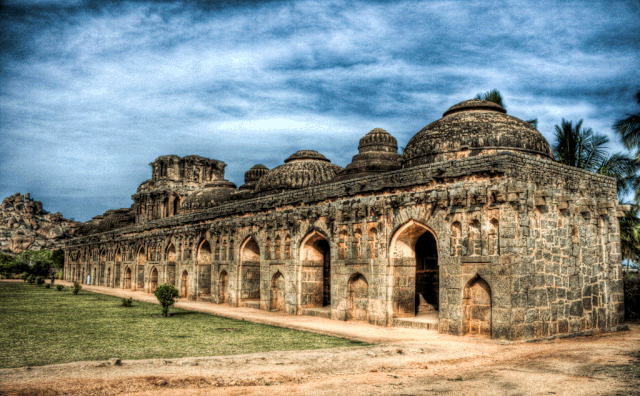
‘Namma Hampi’ is not part of a campaign or tourism gimmick; it is all about cultural identity and a sense of pride for the Kannada people who have preserved their historical marvels with reverence through the ages.
It is to show what Hampi for artists means in contemporary times and how artists Lokesha R and Bhyrava B M have interpreted the legacy with different styles using the same medium — watercolour — with intriguing details. The show, thus, leaves an impression of how modern artists revisit architectural heritage beyond its aesthetic appeal, exploring the cultural and historical evolution through time.